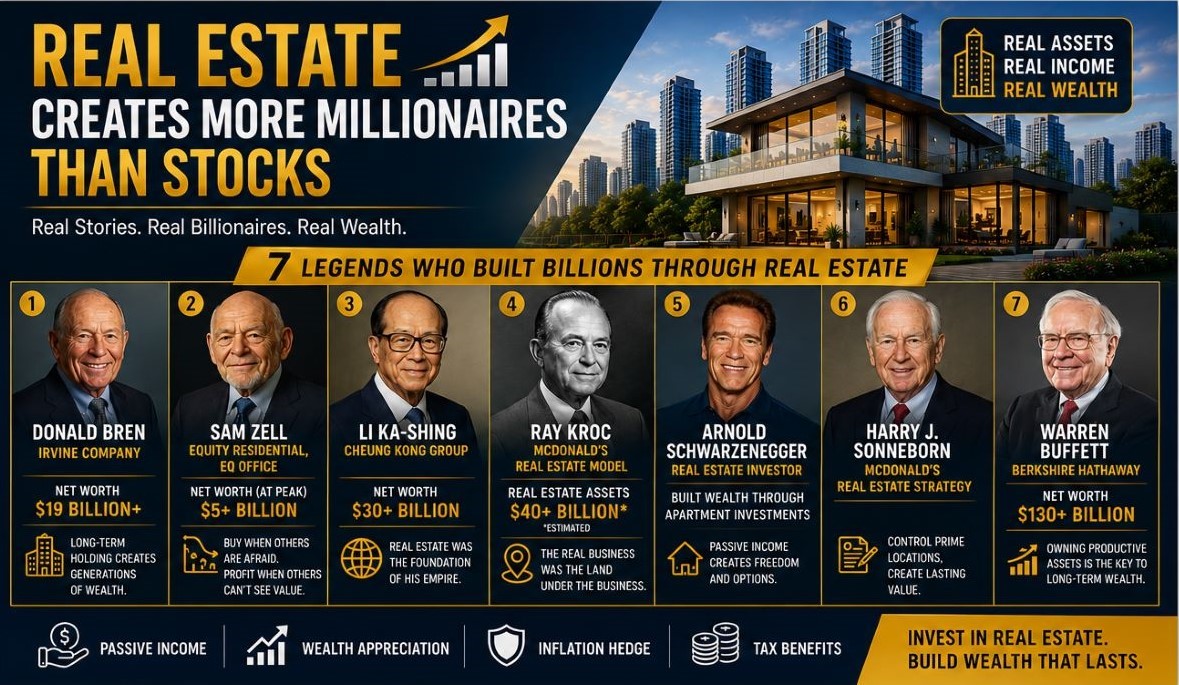
Why Real Estate Creates Extraordinary Wealth
Many people believe wealth is created only through technology companies or stock investing.
However, some of the world's richest individuals built their fortunes primarily through real estate ownership, development, and strategic property investment.
Their stories demonstrate a common principle:
- Own appreciating assets that generate cash flow.
1. Donald Bren
Estimated Net Worth: Approximately $19 Billion.
Donald Bren is the owner of the Irvine Company, one of America's largest private real estate companies.
His company owns:
- Hundreds of office buildings
- Apartment communities
- Shopping centers
- Hotels
- Prime California land
According to Forbes data cited in his biography, he became America's wealthiest real estate developer through a long-term "buy and hold" strategy.
Investor Lesson
Don't focus only on buying.
Focus on:
- Holding quality assets
- Compounding appreciation
- Generating recurring income
2. Sam Zell
Known as "The Grave Dancer"
Estimated Net Worth at peak: Billions through real estate investments.
Sam Zell started by purchasing apartment buildings while still young and eventually built major real estate companies including Equity Residential and EQ Office.
He became famous for buying distressed assets when others were afraid.
Investor Lesson
Great opportunities often appear during market uncertainty.
3. Li Ka-shing
Estimated Wealth: More than $30 billion.
Li Ka-shing started with a small business and eventually built one of Asia's largest property empires through the Cheung Kong Group. His success expanded into infrastructure, telecom, and energy, but real estate was the foundation of his fortune.
Investor Lesson
Real estate can become the platform for broader wealth creation.
4. Ray Kroc
Many people think Ray Kroc became wealthy from hamburgers.
The reality is more interesting.
McDonald's growth accelerated because the company owned the land beneath many franchise locations through its real estate strategy. The real estate model became one of the most important financial decisions in McDonald's history.
Today, McDonald's real estate holdings account for tens of billions of dollars in assets.
Investor Lesson
Sometimes the real business is the real estate.
5. Arnold Schwarzenegger
Before becoming a Hollywood superstar, Arnold invested his earnings into apartment buildings in California.
According to investment accounts discussing his career, rental income from apartments helped him achieve financial independence before his acting career exploded.
Investor Lesson
Passive income creates freedom to pursue bigger opportunities.
6. Harry J. Sonneborn
Harry Sonneborn helped create the McDonald's real estate model.
His insight was simple:
"We're not in the hamburger business; we're in the real estate business."
The real estate structure he helped implement remains a core driver of McDonald's asset value today.
Investor Lesson
Control valuable locations, not just products.
7. Warren Buffett
Although Warren Buffett is famous for stocks, he has repeatedly emphasized investing in productive assets and has owned real estate investments through various structures. He remains one of the strongest advocates for long-term asset ownership and compounding wealth.
Investor Lesson
Long-term ownership is often more powerful than frequent trading.
Common Traits Among Real Estate Billionaires
Despite different backgrounds, these investors followed similar principles:
- Long-term thinking
- Asset ownership
- Cash flow focus
- Strategic leverage
- Patience
- Buying during uncertainty
What CEOs, VPs and High-Income Professionals Can Learn
You don't need billions to apply these lessons.
A senior executive can begin by:
• Building rental income
• Owning commercial assets
• Investing in growth corridors
• Diversifying across markets like NCR, Dubai and international opportunities
The objective isn't merely buying property.
The objective is owning income-producing assets.
Final Thought
Stocks can create wealth.
Businesses can create wealth.
But history repeatedly shows that ownership of high-quality real estate has created some of the world's largest fortunes.
The reason is simple:
Real estate combines cash flow, appreciation, leverage, and long-term wealth preservation in a single asset class.