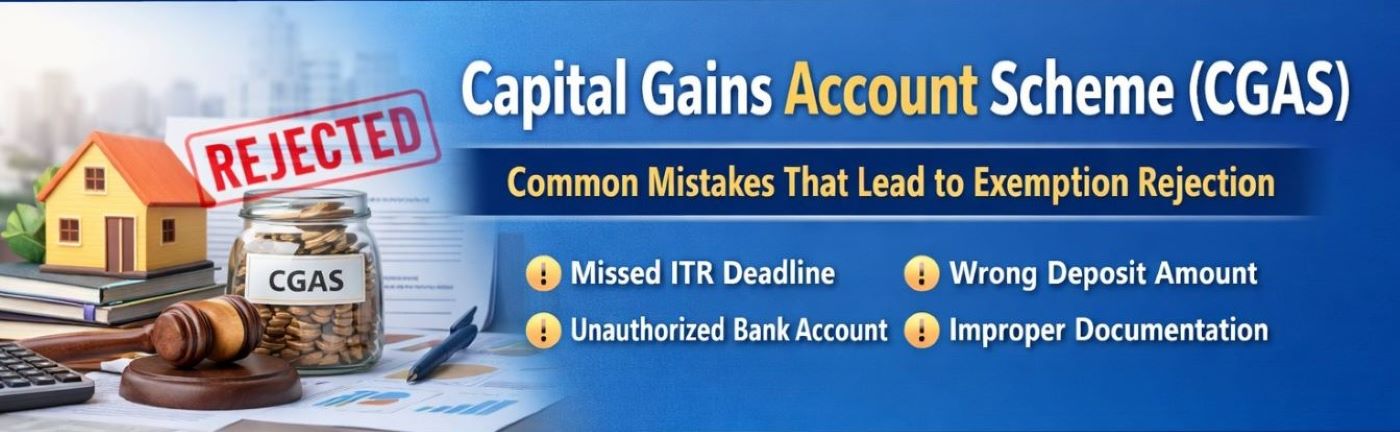
Real estate investors often assume that claiming exemption under Section 54 or 54F is straightforward. However, many exemptions are rejected due to improper compliance with the Capital Gains Account Scheme (CGAS).
If you’re selling property in India and planning to reinvest to save tax, understanding CGAS rules is crucial.
What is Capital Gains Account Scheme (CGAS)?
The Capital Gains Account Scheme (CGAS) was introduced by the Government of India in 1988 to allow taxpayers to park their unutilized capital gains before the due date of filing their income tax return.
It helps taxpayers claim exemption under:
- Section 54 – Sale of residential property, reinvestment in another residential property
- Section 54F – Sale of any capital asset, reinvestment in residential property
- Section 54EC – Investment in specified bonds
If the capital gain amount before the return filing due date, the unspent amount must be deposited into a CGAS account.
Types of CGAS Accounts
There are two types of accounts:
- Account Type A – Savings Account
- Works like a regular savings account
- Suitable when funds are needed in stages
- Account Type B – Term Deposit Account
- Similar to a fixed deposit
- Suitable when funds are not immediately required
Common CGAS Mistakes That Lead to Exemption Rejection
1. Not Depositing Before Due Date
One of the biggest mistakes is missing the due date under Section 139(1).
Even if you plan to invest later within the allowed 2–3 year window, the unutilized capital gain must be deposited before filing your ITR. Courts have sometimes allowed Section 139(4) benefit, but relying on this is risky.
Result: Exemption may be denied.
2. Depositing Net Sale Proceeds Instead of Capital Gains
Under Section 54F, the entire net consideration must be invested, not just the capital gain.
Many taxpayers mistakenly deposit only the capital gain amount.
Result: Proportionate exemption gets reduced.
3. Opening CGAS in Wrong Bank or Incorrect Format
CGAS accounts can only be opened in authorized public sector banks.
Common errors include:
- Opening a regular savings account instead of CGAS
- Not selecting correct account type
- Incomplete documentation
Result: Account not considered valid under tax rules.
4. Using Funds for Non-Eligible Purposes
Funds withdrawn from CGAS must be used strictly for:
- Purchase of residential property
- Construction of residential property
Using funds for:
- Plot purchase only (without construction within time limit)
- Personal expenses
- Loan repayment unrelated to new property
can lead to rejection of exemption under Section 54 or Section 54F.
5. Not Utilizing Funds Within Time Limit
Time limits:
- Purchase: 1 year before or 2 years after sale
- Construction: 3 years after sale
If CGAS funds remain unutilized after the deadline:
- The unspent amount becomes taxable as capital gains in the year when time limit expires.
6. Closing CGAS Account Without Approval
To close CGAS:
- You need approval from the Assessing Officer
- Proper documentation must be submitted
Premature closure without compliance can create tax complications.
7. Ignoring Documentation & Withdrawal Proof
Withdrawals require Form C.
Failure to maintain:
- Construction invoices
- Purchase agreement
- Payment receipts
can result in scrutiny issues.
Proper documentation is critical for real estate tax planning in India.
Practical Case Study Example
Mr. Sharma sold a residential property and earned ?60 lakh in long-term capital gains.
He planned to construct a house but:
- Filed ITR without depositing unutilized gains into CGAS
- Assumed he had 3 years to invest
During assessment, exemption under Section 54 was denied due to non-deposit before due date.
Tax liability increased significantly with interest.
How to Avoid CGAS Rejection
Deposit before ITR due date
Deposit correct amount (Capital Gain or Net Consideration as applicable)
Use authorized banks only
Maintain full documentation
Track construction timelines
Consult a CA before filing return
Why CGAS Compliance Matters for Real Estate Investors
For property investors, NRIs, and high-value property sellers, CGAS compliance is not optional — it directly impacts:
- Long-term capital gain exemption
- Tax liability
- Cash flow planning
- Investment returns
Even a small technical mistake can result in lakhs of rupees in additional tax.
Conclusion
The Capital Gains Account Scheme (CGAS) is a powerful tax-saving tool under Sections 54, 54F, and 54EC. However, improper execution leads to exemption rejection and heavy tax burden.
If you are selling property in India, plan your capital gains tax strategy in advance. Proper structuring, documentation, and timely deposit into CGAS can protect your exemption and maximize your real estate returns.