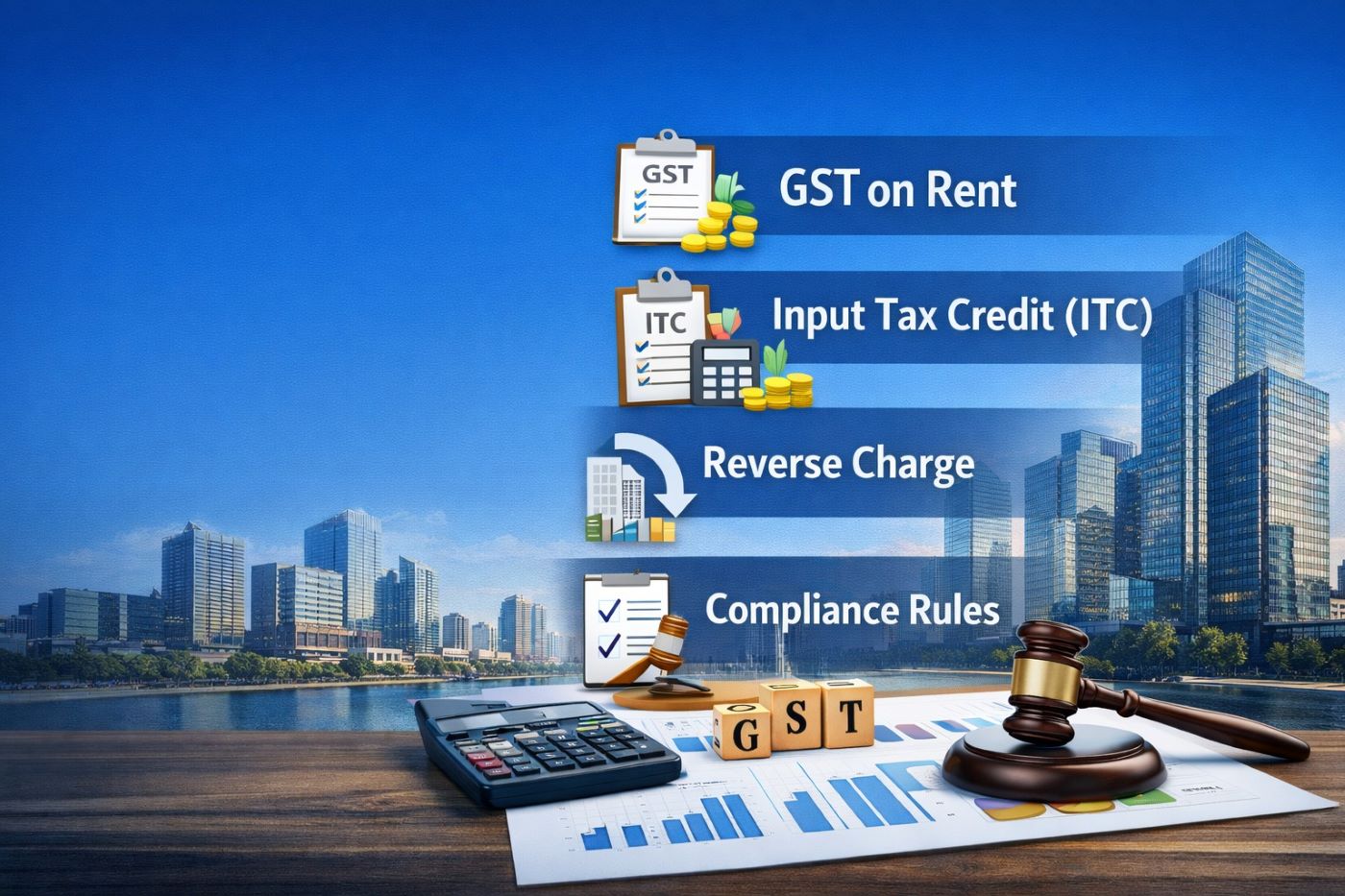
Commercial property leasing is one of the most stable income-generating strategies for real estate investors in India. However, many landlords and tenants still struggle to understand:
- When is GST applicable on commercial rent?
- Can landlords claim Input Tax Credit (ITC)?
- What happens if the tenant is unregistered?
- Is GST applicable on security deposits?
Let’s break down the GST impact and input credit rules in a simple and practical way.
1. Is GST Applicable on Commercial Property Leasing?
Yes.
Leasing or renting of commercial property (offices, shops, warehouses, co-working spaces, IT parks, etc.) is treated as a supply of service under GST law.
GST Rate on Commercial Rent: 18% GST
This applies when:
- The landlord is registered under GST.
- The aggregate annual turnover exceeds ?20 lakh (?10 lakh in special category states).
2. When Does a Landlord Need GST Registration?
GST registration becomes mandatory if:
- Total rental income exceeds ?20 lakh per year.
- Commercial rent + other business income together exceed ?20 lakh.
Important: Even if residential rental income is exempt from GST, it still counts toward the ?20 lakh threshold for registratio
3.Who Pays GST – Landlord or Tenant?
Scenario A: Tenant is Registered
- Landlord charges 18% GST.
- Tenant pays GST along with rent.
- Tenant claims Input Tax Credit (ITC) (if used for business).
- Scenario B: Tenant is Unregistered Business
- Landlord still charges 18% GST.
- Tenant cannot claim ITC.
Scenario C: Government Department as Tenant
GST may apply under Reverse Charge Mechanism (RCM) depending on notification and registration status.
4.What is Input Tax Credit (ITC) in Commercial Leasing?
Input Tax Credit allows adjustment of GST paid on expenses against GST collected on rent.
Landlord Can Claim ITC On:
- Construction services (if property is for leasing business)
- Repair & maintenance
- Brokerage services
- Legal and consultancy charges
- Property management services
Important Condition:
ITC is allowed only if:
- Property is used for taxable commercial leasing.
- Proper GST invoice is available.
- GST returns are filed regularly.
ITC is blocked for certain construction-related expenses if conditions under Section 17(5) apply.
5.GST on Security Deposit – Is It Applicable?
- Refundable security deposit → No GST (if not adjusted toward rent).
- If adjusted as rent → GST applicable.
- If forfeited due to breach → GST may apply.
Clarity in lease agreement wording is very important.
6.GST on Maintenance & CAM Charges
If landlord collects Common Area Maintenance (CAM) separately:
- GST @18% applies.
- If part of composite supply of renting → GST applies on total amount.
7. Example – Practical Understanding
Monthly Commercial Rent: 1,00,000
GST @18%: 18,000
Total Payable by Tenant: 1,18,000
If tenant is GST registered:
- 18,000 can be claimed as ITC.
- Effective cost remains 1,00,000.
If tenant is not registered:
- 18,000 becomes additional cost.
8.Compliance Requirements for Landlords
- GST Registration (if applicable)
- Monthly/Quarterly GST Returns (GSTR-1, GSTR-3B)
- Proper Tax Invoices
- E-invoicing (if turnover exceeds threshold)
- Annual Return (if applicable)
Non-compliance can lead to:
- Penalty
- Interest
- ITC reversal
- Notices from GST department
9.Common Mistakes Investors Make
Not taking GST registration after crossing 20 lakh
Not charging GST to registered tenants
Claiming ITC without valid invoice
Confusing residential rent exemption with commercial lease
Ignoring GST on CAM charges
10. Tax Planning Tip for Commercial Property Investors
If structured properly:
- Commercial leasing can be run as a business entity.
- ITC can significantly reduce effective tax cost.
- Leasing through LLP or Pvt Ltd may improve compliance clarity.
- GST planning should align with Income Tax and Capital Gains strategy.
For investors in NCR, Noida, Gurugram & commercial hubs, proper structuring avoids unnecessary litigation.
Conclusion
Commercial property leasing attracts 18% GST, but smart planning can neutralize its impact through Input Tax Credit.
Landlords must ensure:
- Proper GST registration
- Timely compliance
- Clear lease agreements
- Correct invoicing
For serious real estate investors, GST is not a cost — it is a pass-through tax when structured correctly.